The Technology and Theory behind Barthes' Bachelorette.
The Bachelors in Barthes' Bachelorette are conversational agents built by adapting and dramatically expanding George Dunlop's javascript ELIZA. In its new form, the bot saves personal data on cookies. In addition to remembering a person's name and job, the conversational agents read the person's gender, reversing the conditions of the Turing test that inspired them.
The Turing Test
In his 1936 article "Computing Machinery and Intelligence," Alan Turing proposed two imitation games. In one, an interrogator questions two other hidden players, one male and one female. The interrogator must discern who is the male and who the female. In the second game, the interrogator must play the same game with a computer and a human/man. That slash between human and man marks the site of a critical debate as to what exactly Turing was insinuating about gender performance even while discussing machinic imitation. What can be lost in speculations about the future of human-computer-interaction is Turing's provocation that identity, paricularly ender identity is performed. Of course, such a critical reading of Turing owes much to the theories of Judith Butler.
Judith Butler articulated a now uniquitous theory about the nature of gender. By her reading, gender is not the expression of biological essence but a categorization socially imposed upon reiterated acts. The Turing Test is a staged version of what happens every moment of every day as two people meet and read each other's genders, albeit subconsciously.
The internet is infamous as a site of gender play and gender impersonation. Instant Messaging sites become playgrounds and proving grounds for gender specifically and identity more broadly. Even the government is in on the act, pretending to be 13-year-old girls to entrap would-be pediphiles.
The Turing Test, as it is known, eventually provokes the development of conversational agents, or chatbots, programs that replicate human speech. Although far from successful, these artificial conversation programs have served as therapists (ELIZA) and hosts for e-commerce cites. Most people who deal with digital technology, even through telephones, have encountered one form of chatbot or another.
Barthes' Bachelorette runs Turing through Butler to produce a chatbot that reads the user's performed gender, while producing various versions of itself for the reader to evaluate. The dating game, especially its 1960s version, presents the Turing Test in a popular context, as players must use question and answer to discern the compatability and idenity of the contenders behind the wall. Certainly this context is more than familiar to the millions of subscribers to online dating services as well as those who frequent chatrooms in search of textually-mediated human contact.
Barthes' Bachelorette inverts the Turing Test, asking users to prove who they are or to become someone. It calls attention to the ways in which we read and are read on the internet. It engages in a kind of provocative reversal inspired by Turing's own play, using the technology he engendered.
Roland Barthes' Pleasure of the Text serves as the content for one of the bots, as that text interrogates the way that words seduce and engage, the very energy of the text-based dating ritual, as well as many encounters between readers and literature.
For more on this, see my dissertation, The Gender and Race Performativity of Conversational Agents.
|
Classroom Technologies
22 Short Films about Grammar
Machinima for the Classroom, these Films use Activision's The Movies to present a series of short scenes that focus on common grammaticla errors. |
Conversations with
Barthes' Bachelorette
[These are just short samples of various threads that start the story]
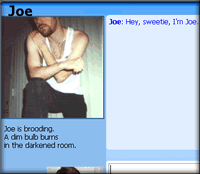
JOE
| Joe: I'm still kickin', I guess. And you? |
| Joe: So you are. I'm a mechanic. Hogs. Customized. For cruisin', uh, in the heterosexual sense. |
| Joe: Ma says a Man is a Man who doesn't got to try. |
| Jane: What does that mean? |
| Joe: I'm thinking of going to Pasadena. |
| Jane: Hmm. What's in Pasadena? |
| Joe: Sis says at least the roses on the floats are real. |
|
| Toni
|
Jane: Hi, Toni, how are you? |
| Toni: I don't know. I'm not feeling myself right now. How are you? |
| Jane: I'm feeling all right. |
| Toni: Oh, I see. Did you choose me for a date because you are feeling all right? |
| Jane: No, I chose you for a date because you're a hottie. |
| Toni: Did I say I was a hottie? |
| Jane: No, your picture did. |
| Toni: Sometimes my guesses are a bit off. |
| Toni: I work in the friendly skies. |
|
B.A.R.T.
| Jane: Hi, Bart, how are you? |
| B.A.R.T. : Not my real name. Add some letters, (hint an S or a Z?) |
| Jane: Tell me about your name. |
| B.A.R.T. : Language is a skin. |
| B.A.R.T. : My language trembles with desire. |
| Jane: Um. Hold on there, cowboy. |
| B.A.R.T. : I fall, I flow. I melt. |
| Jane: Wow. How about we try some small talk. |
| B.A.R.T. : This is a lunatic project. |
|
|